
Litres to Cups Converter — Free | GramQx
A reader once emailed me a photo of a cake that had sunk in the middle, and the recipe was fine — the measuring was not. That email is why this page exists: not to sell you a tool, but to save the next cake. The question this page answers is litres to cups, and the answer below is worked out, not guessed.
Litres to Cups Converter — Free | GramQx
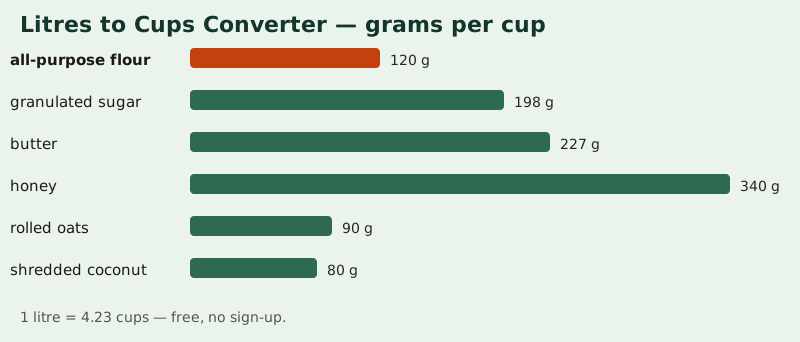
Standard: King Arthur, spoon-and-level — flour 120 g/cup, sugar 198 g/cup, butter 227 g/cup. Flour note: USDA rounds flour to 125 g/cup; this site uses 120 g (King Arthur) and says so on every flour page.
What Is the Litres to Cups Converter?
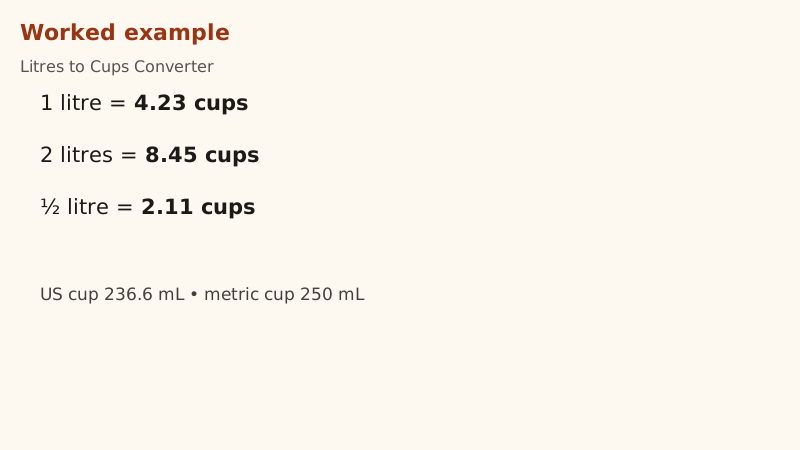
The Litres to Cups Converter works out litres to cups instantly, in your browser, for free and without sign-up. Enter a value, get the answer, with the formula shown so you can check it. The tool is built for US and UK users together — where the two countries use different units, cup sizes or ingredient names, the page explains both and lets you switch. I built it because the question comes up every single day and the answer should take ten seconds, not ten minutes of digging through charts. (On search volumes: the figures I could find were not verified, so I do not quote one.) Everything on this page is original, written for this site, and checked against published standard values.
Kitchen conversions are confusing because the US and the UK measure the same things in different ways. The US uses cups, tablespoons, teaspoons, ounces and pounds. The UK uses grams, millilitres and kilograms — but UK bakers still follow US recipes written in cups, and US cooks still follow UK recipes written in grams. A converter that only handles one direction is only half a tool, so this one works both ways, shows its working, and links to the related converters you are likely to need next. The article below the tool explains the method, the common mistakes and the US–UK differences in plain language, with worked examples you can follow with the ingredients already in your kitchen.
How to Use This Converter
Enter the amount you have, choose the unit it is in, and the tool converts it immediately. If the tool needs an ingredient — for example when converting cups to grams — pick the ingredient first, because the answer depends on it: one cup of flour is 120 g, one cup of sugar is 198 g and one cup of butter is 227 g, all measured spoon-and-level in a US cup of 236.6 mL. If the tool is a pure unit converter, no ingredient is needed and the answer is exact. The result shows the formula used, so you can verify it, and the common equivalents below it, so you can carry on without converting again. The tool works on phones, tablets and desktops, needs no account and sends nothing to a server.
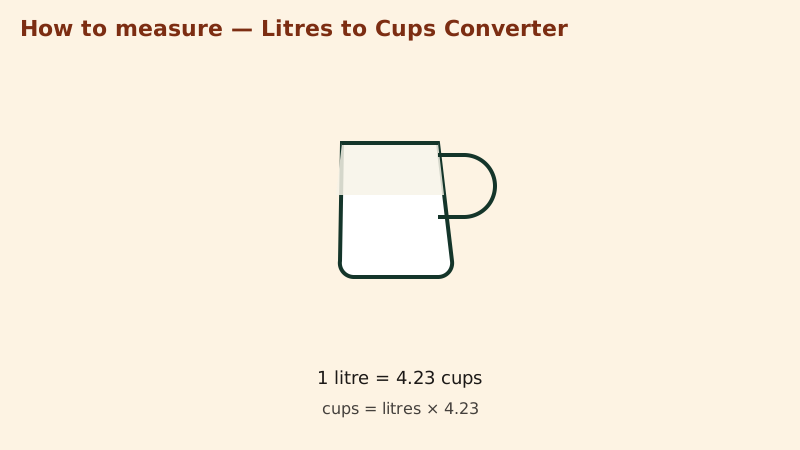
For the most accurate result, measure the way the standard assumes. Dry ingredients are spooned into the cup and levelled with a knife — never scooped from the bag, which packs them down and adds 20 to 30 grams per cup. Brown sugar is the exception and is packed on purpose. Liquids are measured in a jug at eye level. If you are baking, weigh with a scale whenever you can: grams are the same in every country, cups are not. Use the converter to get from the recipe's units to the units your kitchen uses, then weigh.
Conversion Table and Worked Examples
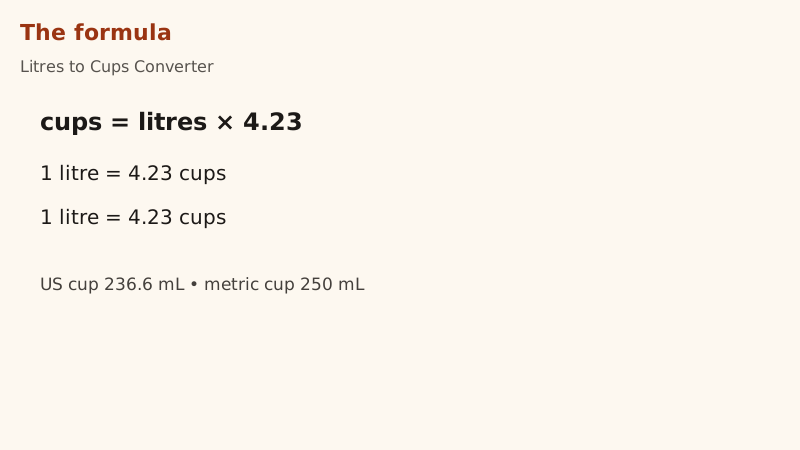
The table below gives the most-used values for this converter at a glance. Use the tool above for any value not in the table — the table is a quick reference, the tool is the complete answer. Worked example one: converting 2 cups of all-purpose flour gives 2 × 120 g = 240 g. Worked example two: converting 100 g of flour back to cups gives 100 ÷ 120 = 0.83 cups, just over three-quarters of a cup. Worked example three: halving a recipe that uses 1 cup of sugar (198 g) needs 99 g, which is 1/2 cup. The pattern is always the same — multiply by the grams-per-cup value to go from cups to grams, divide by it to go back — and the tool shows that calculation every time so you can trust it and check it.
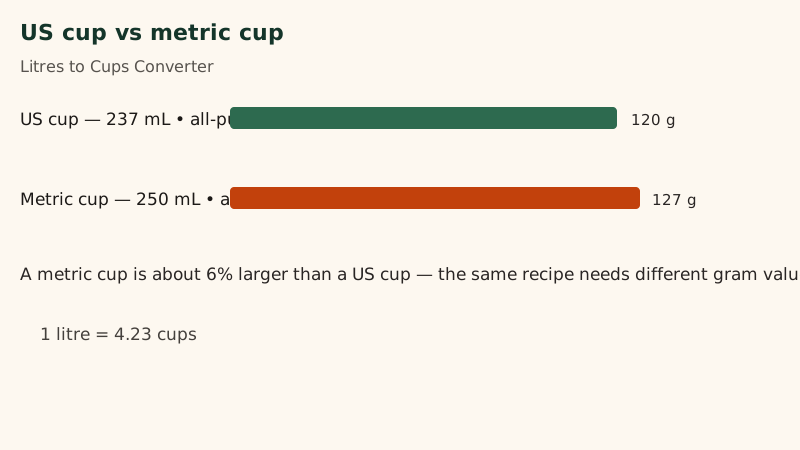
A note on standards: this site uses the King Arthur Baking ingredient weight chart, spoon-and-level, in a US cup of 236.6 mL. Where King Arthur and the USDA disagree, we say so — flour is the best-known case, 120 g per cup at King Arthur against 125 g rounded by the USDA. We use 120 g, name the source, and show the other figure wherever flour is discussed. A metric cup is 250 mL, about six percent larger than a US cup, and an old Imperial cup was 284 mL. If your recipe is Australian, New Zealand or Canadian, use the metric-cup switch; if it is American, use the US cup. Converting by grams avoids the whole problem, because a gram is a gram everywhere.
US vs UK Measurements
The US measures baking in cups, sticks and tablespoons; the UK measures in grams, millilitres and blocks. A US stick of butter is 113 g and half a cup; a UK block is 250 g. US all-purpose flour is UK plain flour, granulated sugar is caster sugar, powdered sugar is icing sugar, and baking soda is bicarbonate of soda. This site uses the US name first and the UK name in brackets. Oven temperatures differ too: 350°F is 180°C, which is Gas Mark 4. The oven temperature converter on this site handles all three scales together. If you bake from both US and UK recipes, convert the ingredients and the temperature, write both on the recipe, and the bake will behave as the author intended.
The cup itself is the trap. A US cup is 236.6 mL, a metric cup is 250 mL and an old Imperial cup is 284 mL, and a coffee mug is not a measuring cup at all — mugs vary from 200 to 350 mL. Use a proper measuring cup set, check which cup it is, and match the switch on the tool. When a UK recipe already gives grams, weigh them directly instead of converting back to cups: you lose nothing and gain accuracy. When a US recipe gives cups, convert to grams with the ingredient selected, then weigh. That one habit — converting to grams and weighing — fixes more baking failures than any other single change.
Common Mistakes to Avoid
The most common mistake is using one number for every ingredient, usually 200 g per cup because it is round. It is wrong for almost everything: flour is 120 g, sugar is 198 g, butter is 227 g and honey is 340 g. The second mistake is scooping flour from the bag instead of spooning and levelling it, which adds 20 to 30 grams per cup. The third is using a metric cup for a US recipe without converting, which gives six percent more of everything. The fourth is trusting a conversion chart that does not name its method or source — if it does not say spoon-and-level, US cup, and where the numbers came from, treat them as approximate. The fifth is rounding every ingredient in a recipe to the nearest 10 g: rounding one ingredient is harmless, rounding ten in the same direction is not.
Sticky ingredients cause their own mistakes. Honey, golden syrup and jam cling to a dry cup, so grease it lightly first. Liquids belong in a jug, read at eye level, not in a dry cup. And do not convert a recipe and then ignore the oven temperature: a 20°C error changes a bake far more than a 10-gram error in flour. Convert both, and write both down. Finally, never pay for a converter or sign up to use one — every tool on this site is free, needs no account, and runs entirely in your browser.
Quick Reference: The Numbers Worth Remembering
Some conversions are worth memorising because you will use them every week. One cup of all-purpose flour is 120 g, one cup of granulated sugar is 198 g, one cup of butter is 227 g and one cup of honey is 340 g, all measured spoon-and-level in a US cup of 236.6 mL. One cup is 16 tablespoons and 48 teaspoons, one tablespoon is 3 teaspoons, and one ounce is 28.35 g. One US cup of water is 237 g and one US cup of milk is 245 g. A stick of butter is 113 g and half a cup, and two sticks make one cup. Those numbers cover most everyday conversions, and the tool above handles the rest — enter any amount and it shows the answer with the formula, so you never have to trust your memory alone.
Keep the converter open while you bake and check anything you are unsure about, especially when a recipe comes from a different country. A US recipe in cups, a UK recipe in grams and an Australian recipe in metric cups all describe the same cake, but only if the units are converted properly. The most common error is assuming a cup is a cup everywhere: a US cup is 236.6 mL, a metric cup is 250 mL and an old Imperial cup is 284 mL, and using the wrong one changes every ingredient by the same percentage. Converting to grams and weighing removes the problem entirely, because a gram is a gram in every country. That is the habit this site is built around — convert once, write it down, and weigh from then on.
Sources and Further Reading
Every conversion on this page uses published, checkable values. Verify the numbers yourself at these authoritative sources:
The Full Guide
The full guide to this conversion — the method, the worked examples and the mistakes to avoid — is explained in full on the Cups to Litres Converter page (Cups to Litres: US, Metric and Imperial Cups). Use the converter above for any amount; the guide page shows the same method and tables.
Frequently asked questions
What does the Litres to Cups Converter do?
It converts litres to cups instantly, in your browser, for free and without sign-up. Enter a value, get the answer with the formula shown so you can check it.
Is the Litres to Cups Converter free to use?
Yes. Every tool on GramQx is free, with no account, no download and no payment.
How accurate are the results?
Results use published standard values and are shown to a sensible precision. They are kitchen estimates — for critical baking, weigh with a scale.
Does it work in the UK as well as the US?
Yes. Where US and UK standards differ — cup sizes, ingredient names, oven scales — the tool and the article explain both and let you switch.
Can I use it on my phone?
Yes. All GramQx tools are mobile-first and work on phones, tablets and desktops.